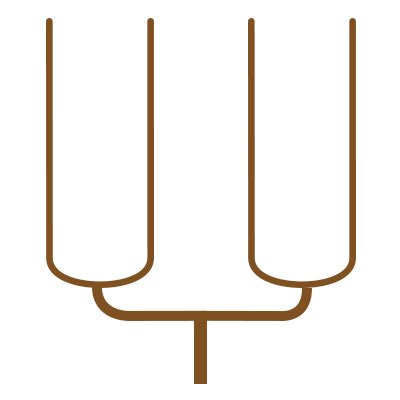
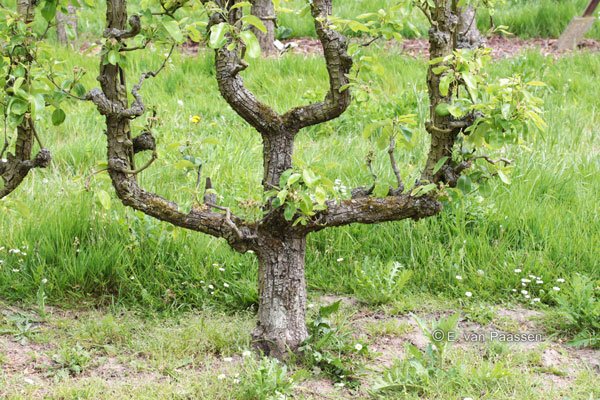
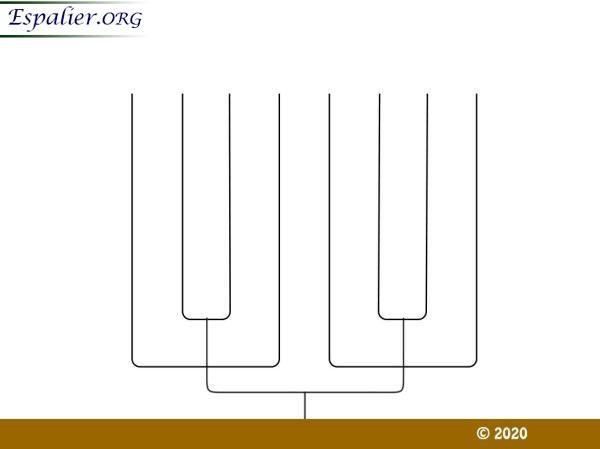
Full name: Verrier palmet (with … framework branches)
Popular name:
Verrier palmet (with … levels)
Synonym:
Nickname:
Historical name:
Verrier palmet
Alternative name:
Spelling variants:
Description
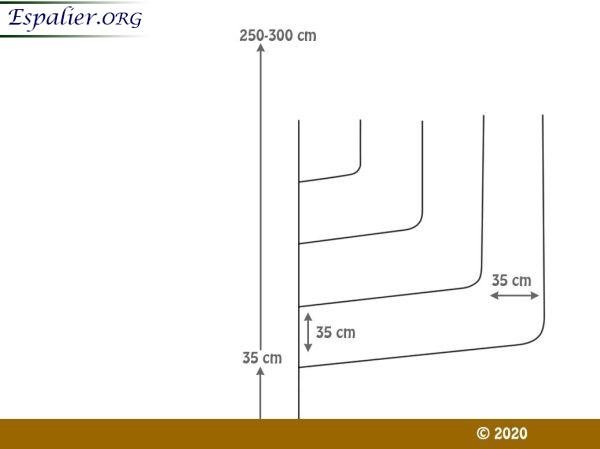
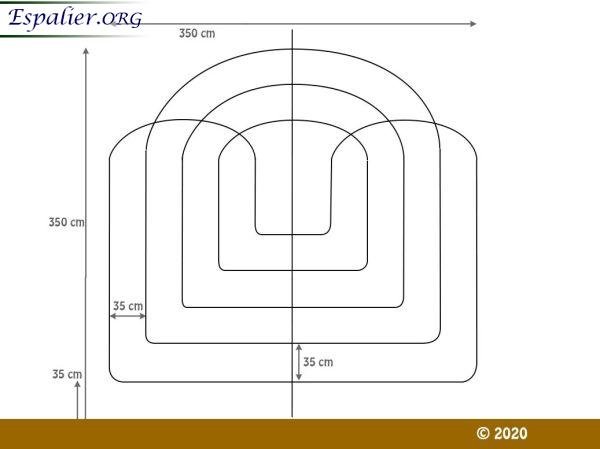
The Verrier Palmet is a variant of the Slanting Palmet where the framework branches are perpendicular to the trunk.
Features:
two-dimensional espalier shape with parallel framework branches that lie in one flat plane
framework branches first run horizontally, then vertically
minimum 2 levels
odd number of framework branches or even number of framework branches
The Verrier Palmet with central leader (‘with trunk extension’) has an odd number of framework branches.
The Verrier Palmet without a central leader (‘without trunk extension’) has an even number of framework branches.
fruitwood is grown short on the stem branch
[mks_icon icon=”fa-thumbs-up” color=”#009900″ type=”fa”] For additional info see main article: Palmette.
Naming
Full Name:
Popular name:
Synonym:
Historical name:
Alternative name:
Spelling variants:
Opinion
Difficult to grow; fairly easy to maintain.
Recommended espalier. Better espalier than the Verrier Palmet, but a Gaucher Palmet is an (even) better alternative.
The disadvantage of the Verrier Palmet is that the middle framework branch is the shortest, while this naturally has the greatest growth power. The result is a strong vegetative growth power ‘in the head of the tree’. This promotes an unbalanced growth, with excessive shoot growth (and scanty fruiting) around the heart branch.
The above-mentioned problem can be solved by gradually grafting a weaker growing variety for each subsequent level during the growing phase.
The Verrier Palmet is a complex espalier shape that requires years of planning by the grower. Before the cultivation begins, the grower must make a design drawing. The grower must then implement this design purposefully and consistently for years. Design errors in complex palmette shapes are virtually impossible to correct afterwards.
Some advice for those who want to grow a Verrier Palmet themselves:
choose a variant without a heart branch
choose a multi-variety espalier Graft a different variety for each subsequent layer, whereby the growth force gradually decreases upwards. The tree will then grow more balanced by nature and require less maintenance (pruning). Such trees are not available ready-made. In practice, this will mean that you will have to graft the next variety per floor yourself. Use a cultivar with lower growth power for each subsequent floor.
[mks_icon icon=”fa-thumbs-up” color=”#009900″ type=”fa”] For additional info see main article: Palmette.
Derived Variants
Variants derived from Basic Form
1-sided Verrier Palmet
Double-sided Verrier Palmet with 5 framework branches (including central branch)
Verrier without a Frame Branche
A Verrier Palmet with 4 framework branches
Verrier without a Frame Branche
A Verrier Palmet with 6 framework branches
Roof shaped Verrier Palmet
Sloping Verrier Palmet
Verrier Palmet with surrounding framework branches
Framework branches are connected in pairs
Variants with Multiple Branches
Dubbele Verrier Palmet zij-aan-zij
One tree with two Verrier shapes next to each other
Triple Verrier Palmet side by side
One tree with three Verrier shapes next to each other